Germany is moving towards the B2B electronic invoicing required and in this process, new technical concepts are emerging that companies should be aware of.
One of them is GEBA (German Electronic Business Address/ (Geschäftselektronischer Behördenaustausch), an identifier similar to the Public Billing Portal (PPF) in France and that it will play a key role in the automatic exchange of invoices within the German and European digital ecosystem. Although it is not an obligation today, it is a clear sign of the direction of the market. That is to say, more standardization, more automation and less manual intervention.
Companies that prepare now will have an advantage when electronic invoicing is completely mandatory. Learn how to prepare your SAP environment for this scenario. Keep reading and we'll explain it to you!
E-Invoicing calendar in Germany
Before joining GEBA, let's remember the regulatory context:
2025 → obligation of power receive electronic B2B invoices.
2027 → obligation to emit for companies with a turnover > 800,000€.
2028 → total electronic issuance obligation for all companies.
You can check the details in our article on electronic invoice formats and dates in Germany and in the update of the German model.
What is GEBA?
GEBA is an electronic business identifier that uniquely identifies senders and receivers in data exchange, especially on the Peppol network. It's not a platform, not an invoice format or shipping channel. It's a structured electronic address in 3 complementary segments.
These 3 GEBA segments are:
1 - Company Identifier
Identifies whom is the entity at the legal/fiscal level.
Based on the Wirtschafts-Identifikationsnummer (W‑idNr), guarantees a unique identification of the company and aligns with German tax records.
2 — Unterscheidungsmerkmal
Differentiator within the same economic actor.
It allows Differentiate multiple entities, related establishments, in the case of different headquarters or divisions/branches.
3 — Operational subdirection (optional)
Indicate whither The electronic message must go inside the organization.
Freely defined by the company. It is good for route messages to a department (billing, purchasing, logistics) an internal system (ERP, portal, service) or specific process.
GEBA relationship and electronic invoicing in Germany
One of the major challenges in Germany has been the fragmentation of channels (email, portals, EDI, etc.). GEBA introduces an addressing model that reduces shipping errors, allows automatic routing and facilitates end-to-end automation. This is especially relevant in SAP environments with high volume of bills and shared service centers.
Relationship between GEBA and PEPPOL
GEBA is designed to work within the ecosystem PEPPOL, acting as a reliable identifier for senders and receivers. This reinforces the use of European standards, facilitates automatic exchange and prepares companies for continuous transaction control (CTC) models.
Is GEBA mandatory?
It is currently not mandatory and can coexist with other identifiers such as the VAT ID, GLN or the Leitweg-ID. However, it is part of the German strategy of standardization and automation, so its relevance will increase with the mandatory nature of e-invoicing.
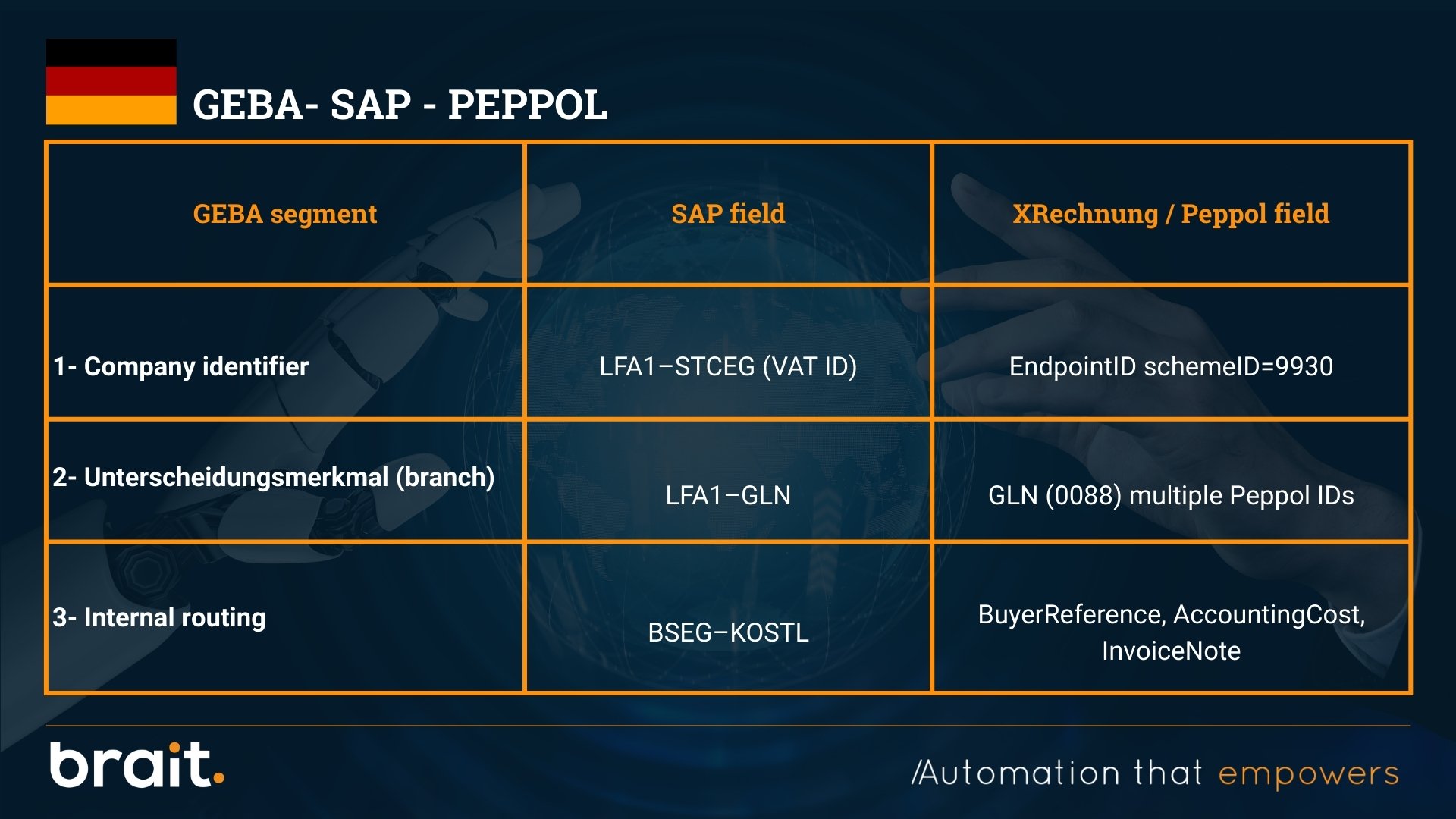
Example of how GEBA is mapped from SAP to Peppol
It should be clarified at this point that there is no “physical GEBA” in the XML, but rather that each segment of the GEBA is translated into PEPPOL/XRechnung fields.
In addition, a company can have a single VAT and several GLN that are registered as another EndPointID in Peppol (segment 2). Let's see it in a table:
What do companies operating in Germany need to do now?
If you operate or invoice in Germany, it is advisable to evaluate if your solution supports PEPPOL. As well as starting to prepare for automatic invoice routing and, above all, adapt your SAP architecture to the new obligations.
This is an opportunity not only to comply with regulations, but to bet on a digital transformation of the SAP ecosystem, which automates accounts payable and receivable or other processes, facilitates document management and treasury, thus promoting greater efficiency in the financial department.
At Brait, we help you bill in Germany
At Brait, we support companies in their adaptation to electronic invoicing in more than 100 countries, including Germany. We take care of:
- SAP integration with PEPPOL.
- Automate financial processes without leaving SAP.
- Intelligent invoice routing.
- SAP architectures prepared for European compliance, LATAM or other countries.
Is your SAP system ready for the German e-invoicing model? Let's talk and discuss it with you.
.jpg)