
OpenText Content Management 26.2 (Extended ECM) represents a significant leap toward an increasingly intelligent Enterprise Content Management system. It is no longer just about storing content, but about letting the system work for you while maintaining full control over governance, compliance, and security through agentic artificial intelligence.
From assistant to agent: the new capabilities of Content Aviator
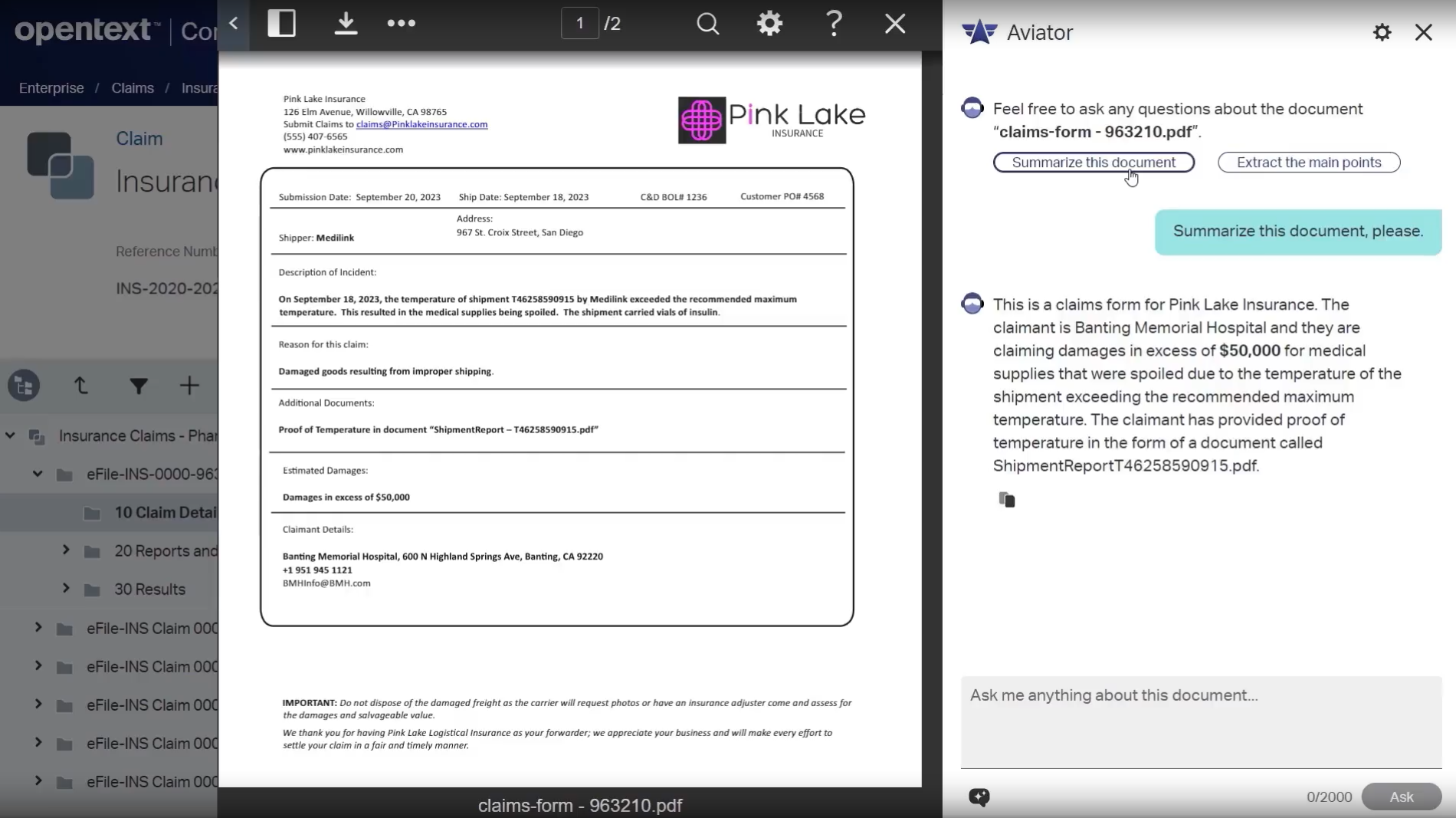
Content Aviator began as a conversational AI assistant. Useful, but still requiring the user to say what to do. In 26.2, it evolves into an autonomous agent capable of executing complex actions based on natural language instructions.
This means that users can:
Generate documents without knowing templates: "Create a vendor contract with standard terms." Content Aviator finds the correct template, fills it with relevant data, and saves it where it belongs.
Organize content without navigating menus: "Move all expired contracts to the legal archive folder." No manual clicks or scattered searches.
Manage users and permissions conversationally: "Add John to my shared documents." Access management is no longer bureaucratic.
Update metadata at scale: documents that arrive uncategorized can now be processed using conversational instructions, maintaining data consistency.
Manage records and compliance: "Place this document on legal hold." Compliance policies are executed without manual exception processes.
OpenText CCM opens a secure path to the private cloud
One of the biggest points of friction in digital transformation is migration. Moving from on-premises to the cloud should be simple. In practice, it is often a maze: Which version is compatible? What data is critical? What settings will be lost? How long will it take?
Content Management 26.2 (Extended ECM) introduces specific migration tooling to solve this. It is the first step in a series of improvements that OpenText will be releasing, but it makes an immediate difference:
• Early readiness analysis: before you start, you know exactly what needs to be migrated, what dependencies exist, and what can be left behind.
• Predictable migration: the tooling is not a trial-and-error process, but a reproducible path based on thousands of previous migrations.
• Context preservation: what matters (content, governed configurations, integrations) travels to the cloud while maintaining its structure and logic.
For organizations trapped in aging on-premises infrastructure, this is liberating. They can modernize without the risk of losing traceability, critical configurations, or audit history.
Smarter governance, operations, and administration
Governance policies are necessary. But when they require 10 steps and specialized technical knowledge, users bypass them. This new version redesigns the administration experience:
Business Administrator home page: Users will have access to an out-of-the-box view with relevant widgets and metrics, all preconfigured.
Expanded Business Administrator access: Administrators can now access the WebReports and Usage Privilege pages.
Records Management metadata bulk updates: Manage metadata bulk update rules directly from Smart View.
Read audit logging: Allows organizations to track when users confirm they have reviewed a document. Critical for compliance in regulated industries.
Simplified role management: Create roles and assign participants directly in side panels, without navigating through complex menus.
It’s all in the details: improved everyday usability
Sometimes, transformation doesn't come from dramatic changes, but from removing daily friction:
• Critical actions are now in the workspace header (Content Aviator, Favorites, Properties) instead of dropdown menus.
• Rename documents before uploading them, rather than after.
• Start deletion workflows directly from document properties, with no intermediate steps.
• Receive alerts when a document is outdated or nearing expiration.
These improvements may seem small. But in an organization where many users interact with documents daily, saving 2 clicks per action adds up to hundreds of hours recovered annually.
The measurable impact of having an intelligent ECM
For organizations with significant document volumes, this translates into:
Reduced manual time: agentic capabilities cut processes that used to take hours down to minutes.
Fewer governance errors: automated actions governed vs. manual intervention = lower risk of non-compliance.
Faster migration: with clear readiness tooling, migrations that once took months can now be optimized to weeks.
Scalability without increased operational costs: the same management platform and the same administrative effort for much more optimized processing.
What this means for companies using SAP with OpenText CCM
If your organization has SAP + OpenText Content Management, 26.2 accelerates the integration between structured processes (SAP transactions) and content (governed documents in OpenText).
Approval workflows that previously required manual document searching, validation, and moving between systems are now executed through conversation with Content Aviator. SAP metadata is synchronized and updated automatically. Audits and compliance reports are generated without human intervention.
Upgrade and improve your OpenText solutions with Brait
If you need technical support to upgrade your version of OpenText CCM, Brait has an expert, certified team ready to help you.
Or if your organization:
• Manage documents scattered across systems and repositories.
• Have manual processes for searching, validating, and approving documents.
• Are considering a move to the cloud but fear losing context or configurations.
• Need to improve visibility and governance without increasing administrative overhead.
...it is time to evaluate how OpenText Content Management can transform your document operations.
Contact us today for a free and dedicated analysis to your system!
.jpg)